CertExams.com Simulator Lab Exercises Answers
Description: The purpose of this exercise is to configure NAT on the source router (NAT inside source) and test for connectivity by pinging a remote router.
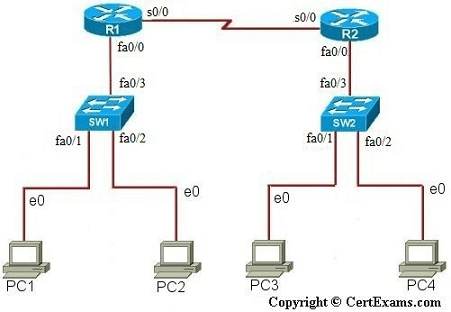
IP Address Assignment Table
| Device | Interface | IP Address | Mask |
| R1 | S0/0 Fa0/0 |
200.200.200.1 |
255.255.255.0 255.255.0.0 |
| R2 | S0/0 Fa0/0 |
200.200.200.2 10.1.1.4 |
255.255.255.0 255.0.0.0 |
| PC1 | 192.168.1.10 | 255.255.0.0 | |
| PC2 | 192.168.1.11 | 255.255.0.0 | |
| PC3 | 10.1.1.1 | 255.0.0.0 | |
| PC4 | 10.1.1.2 | 255.0.0.0 | |
| SW1 | 192.168.1.12 | 255.255.0.0 | |
| SW2 | 10.1.1.3 | 255.0.0.0 |
NAT Mapping Table for Inside Source
| Inside Local | Inside Global |
| 192.168.1.10 | 200.200.200.3 |
| 192.168.1.11 | 200.200.200.4 |
Instructions:
1. Assign IP addresses on all the devices as per the above table
2. Enable routing on all routers (you can use RIP/EIGRP/OSPF routing)
3. Create IP NAT Mapping (Hint: use inside source static command) on R1
4. Define IP NAT Inside and IP NAT Outside interfaces on R1
5. Test for Connectivity from PC1 to R2 by issuing ping command
R1>enable
R1#conf term
R1(config)#interface serial 0/0
R1(config-if)#ip address 200.200.200.1 255.255.255.0
R1(config-if)#no shutdown
R1(config-if)#exit
R1(config)#interface fastethernet 0/0
R1(config-if)#ip address 192.168.1.13 255.255.0.0
R1(config-if)#no shutdown
R1(config-if)#exit
R1(config)#router rip
R1(config-router)#network 192.168.0.0
R1(config-router)#network 200.200.200.0
R1(config-router)#exit
R2>enable
R2#configure terminal
R2(config)#interface fastethernet 0/0
R2(config-if)#ip address 10.1.1.4 255.0.0.0
R2(config-if)#no shutdown
R2(config-if)#exit
R2(config)#interface serial 0/0
R2(config-if)#ip address 200.200.200.2 255.255.255.0
R2(config-if)#no shutdown
R2(config-if)#exit
R2(config)#router rip
R2(config-router)#network 200.200.200.0
R2(config-router)#network 10.0.0.0
PC1:ip address 192.168.1.10 255.255.0.0
PC2: ip address 192.168.1.11 255.255.0.0
R1(config)#ip nat inside source static 192.168.1.10 200.200.200.3
R1(config)#ip nat inside source static 192.168.1.11 200.200.200.4
R1(config)#interface serial 0/0
R1(config-if)#ip nat outside
R1(config-if)#exit
R1(config)#interface fastethernet 0/0
R1(config-if)#ip nat inside
R1(config-if)#exit
R1(config)#exit
R1#
PC1:ping R2
Note: Please refer to the CertExams.com Network Simulator software for complete lab with commands.